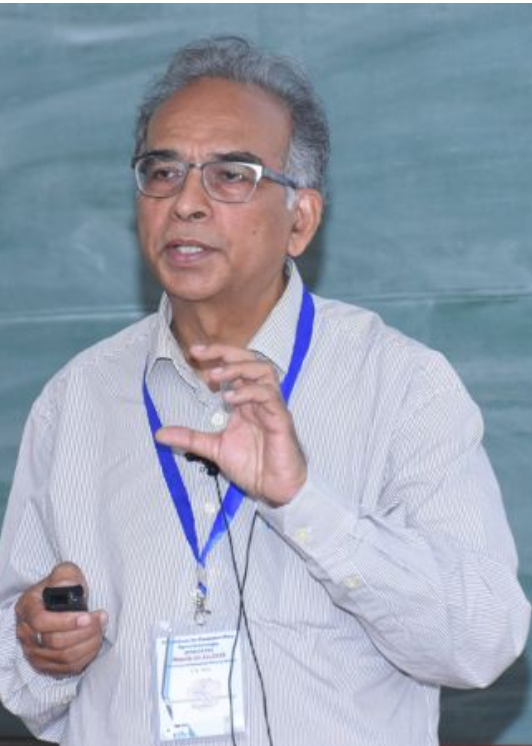
Prof. A.K. Jain
Nuclear Physicist · Professor, IIT Roorkee
Exploring the structure and behaviour of atomic nuclei, and sharing a lifetime of research and teaching.
Research and teaching
I study atomic nuclei: their structure, properties and behaviour. Trained as a nuclear theorist, I have also taken part in experimental investigations, including work on shape mixing and band crossing in magnetic rotational bands. Some of my contributions have been discussed in two review articles in Reviews of Modern Physics, now standard references in the field.
At IIT Roorkee, formerly the University of Roorkee, I taught undergraduate and postgraduate students across a wide range of subjects. These included general physics, nuclear and particle physics, nuclear reactor physics, group theory and angular momentum algebra, classical physics and quantum physics. I also held teaching assignments at Kuwait University, the University of Yangon and Amity University.
Guiding Ph.D. students has been one of the most rewarding parts of my career. Their work across different areas challenged me to keep learning. Collaborations with colleagues around the world have enriched both my understanding of physics and my experience of life.
I continue my research from home and travel regularly to maintain these collaborations.
Education & Qualifications
-
Ph.D. (Physics)
Banaras Hindu University
1972–1977 -
M.Sc. (Physics)
1970–1972 -
B.Sc. (Physics)
1967–1970
Areas of research
- The High Spin Back-bending phenomenon
- Symmetries and Identical Bands in normal deformed nuclei
- Odd-Odd Nuclei, the GM splitting, and the odd-even effects
- Multi-Quasiparticle States
- Super-deformed Bands
- Semi-classical Methods in Nuclear Physics
- Magnetic Rotation Bands
- Anti-Magnetic Rotation (AMR) Bands
- Nuclear Isomers and Generalized Seniority
- Isospin dominance in n-rich systems and nuclear fission
- Applications of Nuclear Physics to Hydrological problems and Nuclear Security
- Nuclear Data Program in India
My life story
Growing up in Banaras
I was born and brought up almost on the banks of the holy river Ganga, in one of the oldest cities of the world, Banaras, now known as Varanasi. My childhood was very simple and solitary. I have always had very few friends. Books in the vast library of my father were my friends. I always looked for new and interesting books. I have loved science since childhood and was always looking for something new to learn.
As the only son, I was admitted to an ordinary school, known as Gautam Junior High School, which was close to our house, in the mohalla of Bhadaini. My father was a scholarly person, always immersed in his literary works in Prakrit and Sanskrit, also the source of family sustenance. I completed Class VIII at Gautam School with a First Division and stood first in my class, something very unusual for that school. I think I was quite ignorant and innocent about the ways of the world. I did not know what a First Division meant; my only concern was whether I would pass the examination. When the results were announced, I enquired with my classmate and friend Ghure Lal, the son of a boatman (a Mallah) and laggard in the class, whether I had passed or failed! When he told me that I had passed in First Division, I was quite perplexed. I asked him to clarify whether that meant a pass or a fail!
Finding my way to science
On getting the news, my father’s acquaintances prodded him to think about my future as I seemed to be doing well in my studies and told him to get me admitted to one of the good schools for further studies. I was eventually taken to the Children’s School on the campus of the Banaras Hindu University (now known as a Central School). The principal of the school flatly refused to admit me; the school was full of children from the families of university professors and other big people in the city. He did not consider me fit to sit with them, being the son of a dhoti clad Pandit. My father then decided to approach his friend in the university, Pandit Vasudev Sharan Agrawal, who lived next to the school and was a well-known Sanskrit scholar and senior professor at the university. He immediately wrote a recommendation letter for me and sent it to the principal.
Eventually, I was given admission in this prestigious school, where we were always told in our science class that Dr. Jayant Narlikar had studied there. Dr. Narlikar actually visited us once when he was in England and a big celebration was held. I was very keen to study science and physics like him. But there was nobody to guide me and I had to guide myself in this totally unknown terrain. The science teacher in the school did not like me and refused to give me the science stream in class X. The story of my getting the science stream is a long one and I reserve it for a future post.
Learning at Banaras Hindu University
Since Children’s School belonged to the BHU, it gave me certain advantages in admission to BHU. After passing my high school board examination (Class X), I could easily get admitted to the Science College for a Pre-University Course, equivalent to Grade 11. My university exposure thus started quite early with a big problem. All science teaching at the university was in English, and I could barely speak or write the language. I could read it but mostly without understanding it. I remember my first exposure to university teaching in a class taken by Dr. V.S. Mathur of the Physics Department. He was very young and smart at that time and spoke fluent English having returned recently from England. I sat numbed without grasping anything. I felt like a dumb person. Learning English on my own was a long process, and a story in itself.
Eventually, I learnt English and completed my B.Sc. and M.Sc. at BHU. I then enrolled for a Ph.D., choosing to work with the well-known nuclear physicist (Padma Shri) Prof. P.C. Sood.
A career at Roorkee and beyond
After my Ph.D. and a brief stint as a Research Associate at BHU, I joined the University of Roorkee as a Lecturer in 1979. I spent my career at Roorkee. The university became the Indian Institute of Technology Roorkee, an institution of national importance, in 2001. I retired in 2015 and remained there as an Emeritus until 2018. I have been working at the Amity University, Noida as a part-time Advisor to the Amity Institute of Nuclear Science & Technology, visiting it off and on. Besides this, I also held a position at Akal University, Punjab as a Distinguished Professor of Physics.